Fillomino Ultimate Guide
A Fillomino puzzle starts with a partially filled grid, the aim of the puzzle is to fill the grid
so that every number n is part of a group of n cells. Groups of the same value may not
touch horizontally or vertically (diagonally is fine).
For example, a cell containing the value 3 must be part of a group of 3 cells containing the value 3.
A cell containing the value 4 must be part of a group of 4 cells containing the value 3.
A cell containing the value 4 must be part of a group of 4 cells containing the value 3.
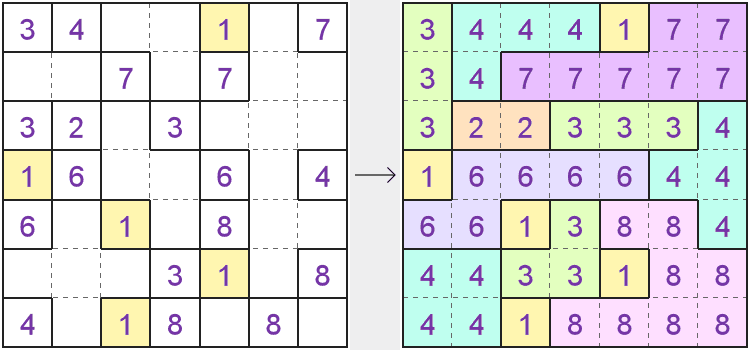
The background colour of each cell will change if they are in a valid group with the correct number of cells.
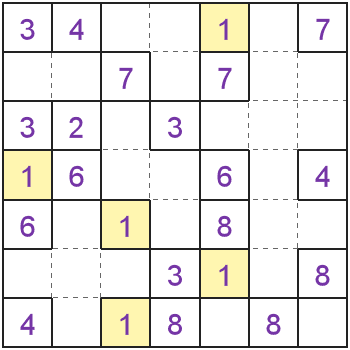
Start with the 1 clues
The 1 clues are the easiest place to start - you don't need to do anything!
Any 1 clues are already in a group of 1 cells, so these are automatically complete.
Forced extensions
Look for cells that can only be extended in one way.
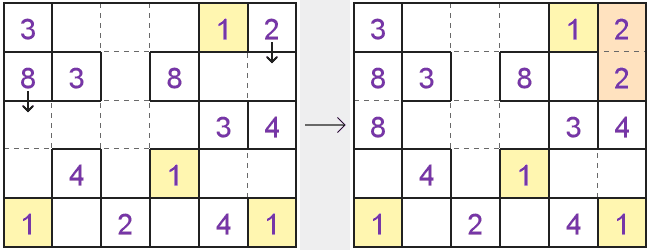
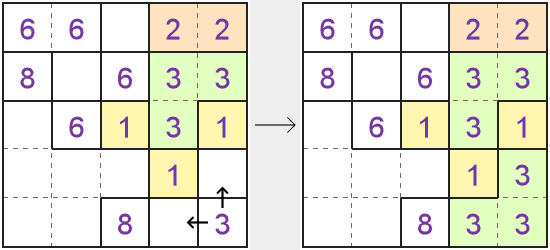
The 8 clue on the left side of the puzzle can only be extended downwards.
Similarly, the 2 clue in the top-right can also only be extended downwards.
Similarly, the 2 clue in the top-right can also only be extended downwards.
Forced extensions can be used again and again throughout solving a Fillomino.
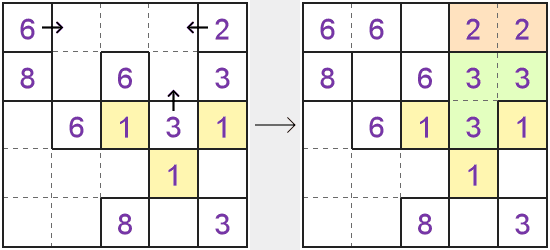
You will sometimes see a situation where an existing block has exactly the right number of cells to expand in to.
Sometimes you need to look a little further ahead when looking for forced extensions.
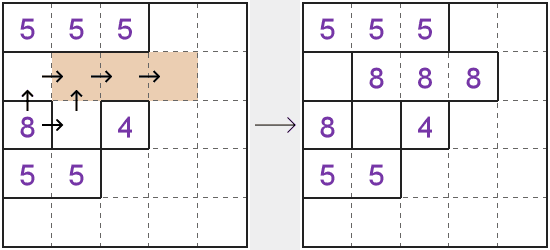
In this example the highlighted 8 clue can immediately extend upwards or to the right. We don't know
which way it will extend - it could be either, or both.
But, by looking a little further ahead, we can see there is a bottlenect, and that it must extend further to the right - the highlighted cells must contain the number 8.
We'll find out later exactly where it extends to.
But, by looking a little further ahead, we can see there is a bottlenect, and that it must extend further to the right - the highlighted cells must contain the number 8.
We'll find out later exactly where it extends to.
Forced extensions can sometimes be a little more complicated, but the concept is the same.
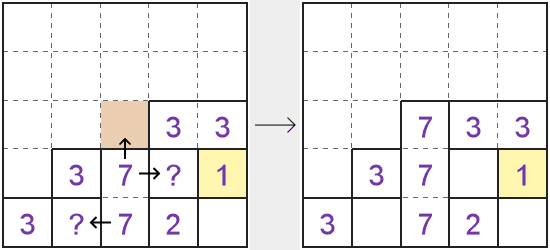
In this example, the 7 region might expand to the left and right, but there isn't enough space there for all 7
cells, so it must extpand upwards.
Illegal extensions
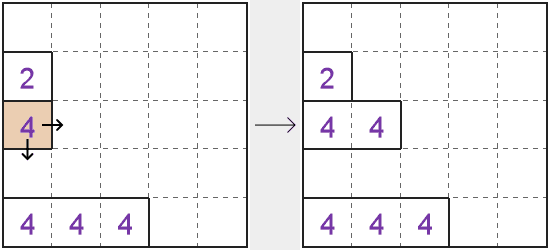
The highlighted 4 region here has two options for extension - downwards or to the right.
Extending downwards would mean that it would join on to the other 4 region below, giving a total of five cells in that region - which makes it too big.
Extending downwards would mean that it would join on to the other 4 region below, giving a total of five cells in that region - which makes it too big.
This means the highlighted 4 region must extend to the right.
Single-option cell
The Fillomino puzzles on PuzzleMadness will always have at least one given for every region, i.e.
you don't need to insert completely new regions in to the grid.
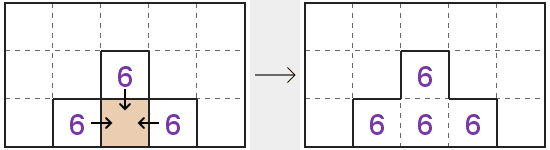
This means that if you have a cell that is surrounded by just one value, you can insert that value in
to the cell.
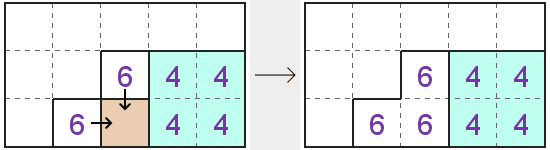
You can also apply this technique if there are other values around the cell, provided they are all in
satisfied regions.
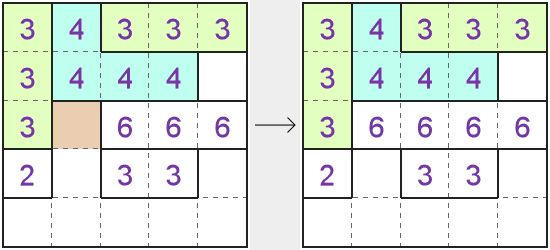
If we know that all regions have at least one starting clue, we can also look at this from the
other point of view - which regions can be extended to reach a given cell?
After all, we know that every cell must belong to a region.
After all, we know that every cell must belong to a region.
Looking at the highlighted cell, the only region that can be extended to reach this cell is the 6 region to it's
immediate right.
Chained deducations
You will sometimes need to look a little ahead and chain a small series of deductions together.
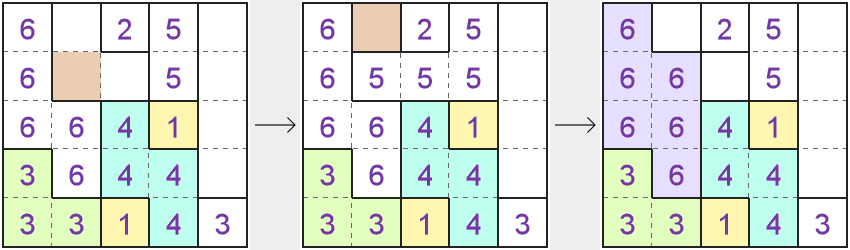
The highlighted cell here has two options for which region can expand in to the cell - the 6 region
and the 5 region. Look ahead to see what would happen if the 5 region was to expand to this cell.
We are now in the position where both the 2 region and the 6 region need to expand in to the highlighted
cell in the second grid, i.e. this state is now impossible.
This means we can conclude that the 6 region must expand in to the original highlighted cell.
Conclusion
Those are all the techniques you need to know to solve the Fillomino puzzles on PuzzleMadness.